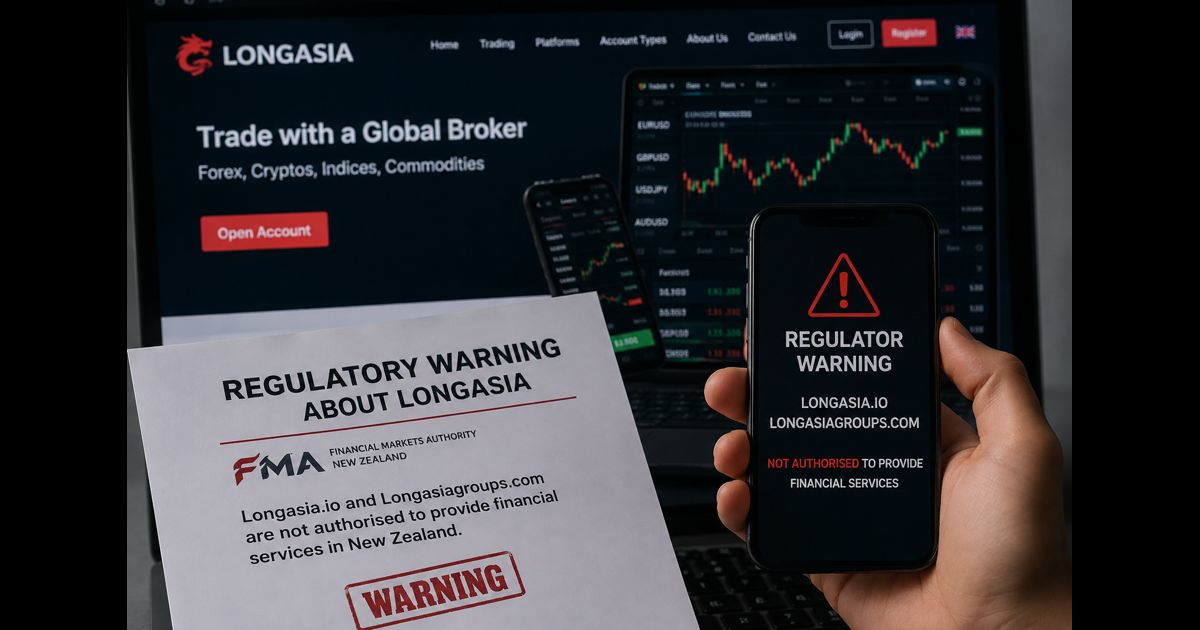
Longasia is associated with online trading websites including longasia.io and longasiagroups.com. These sites promote access to foreign exchange, contracts for difference, cryptocurrencies, metals, indices, and other leveraged products.
Before creating an account, depositing money, or sharing identification documents, it is important to separate the platform’s own marketing claims from information published by financial regulators. The available official information raises serious concerns about the company identity, claimed registration, and ability to provide financial services.
What Financial Regulators Have Reported
New Zealand’s Financial Markets Authority published a warning concerning longasia.io and longasiagroups.com on September 2, 2025.
The authority said the websites offered online trading services while falsely claiming to be operated by a New Zealand company. It stated that the websites were not registered as companies in New Zealand, did not operate from the New Zealand addresses presented on the sites, and were not authorised to provide financial services in New Zealand.
The warning also said the regulator had received reports from investors who were unable to withdraw funds after investing through longasiagroups.com.
IOSCO’s International Securities & Commodities Alerts Network also lists LONG-ASIA-GROUP-NZ-LIMITED as an unregistered or unlicensed entity offering financial products or services. IOSCO’s network brings together alerts issued by participating securities regulators, making it a useful place to check when a platform claims international legitimacy.
These are material facts. A trading platform does not become regulated merely because it shows a company number, displays a certificate, uses financial terminology, or says client funds are protected.
Why a Registration Claim Needs Careful Checking
A company registration, tax registration, anti-money-laundering registration, and financial-services licence are different things.
A business may be incorporated in one country while being prohibited from offering investment services there. A money-services registration may require reporting obligations but may not authorise a business to operate a retail forex or CFD brokerage. A licence can also apply to a different legal entity, different activity, or different website.
For an online broker, the key questions are:
- Which legal entity is accepting the client?
- Which regulator supervises that exact entity?
- Does the regulator’s register show authorisation for retail trading services?
- Does the regulator list the platform’s website domain?
- Is the licence current rather than expired, withdrawn, suspended, or attached to another business?
- Can clients in the relevant country legally use the service?
The answers should come from the regulator’s own register, not a screenshot, badge, PDF, social-media post, or statement on the platform’s website.
Platform Features Do Not Remove Trading Risk
Longasia has advertised familiar brokerage features such as forex trading, CFDs, cryptocurrency CFDs, market analysis, demo accounts, and access through trading software. Those features can make a platform appear established, but they do not confirm oversight or client protection.
CFDs and leveraged forex products are high-risk instruments even when offered by a properly regulated firm. Leverage can amplify small market movements into large losses. A position can lose value quickly, especially during volatile news events, thin market conditions, or sudden price gaps.
Crypto CFDs add another layer of risk because they are usually derivatives rather than direct ownership of cryptocurrency. The client may be exposed to price movements without receiving the underlying asset, private keys, or the protections associated with using a regulated custody provider.
A platform’s advertised spread, leverage, minimum deposit, account type, or trading interface should never be treated as proof that withdrawals will be processed fairly.
The Most Important Test: Can the Operator Be Verified?
A reliable review begins with the legal operator, not with the trading app.
The site should clearly identify the company that enters into the client agreement. Its legal name, registration number, jurisdiction, office address, support contact, and governing law should match across the terms of service, privacy policy, account-opening documents, and regulator register.
Warning signs include:
- Different company names across website pages
- A licence number that cannot be found on the regulator’s register
- A real company name paired with an unrelated website domain
- An address that does not match the regulator’s records
- Vague wording such as “globally regulated” without naming a regulator and licence
- Claims that registration alone proves trading authorisation
- A request to send funds to a personal account, third party, or cryptocurrency wallet
- Pressure to deposit quickly to secure a bonus, account upgrade, or “guaranteed” opportunity
A legitimate financial business should be able to identify the entity behind the service without ambiguity.
Withdrawal Problems Require Fast, Documented Action
Difficulty withdrawing money is one of the most serious issues an investor can face. Delays can sometimes result from identity checks or banking processes, but unexplained delays, repeated requests for extra payments, or pressure to pay a “tax,” “release fee,” or “verification charge” before funds are released should be treated cautiously.
Do not send additional money simply because someone says it is required to unlock a withdrawal. Keep records first.
Save:
- Deposit confirmations and bank or wallet transaction IDs
- Screenshots of account balances and withdrawal requests
- Emails, messages, call logs, and support tickets
- The platform’s terms, fee schedule, and risk disclosures
- Names and contact details used by account managers or introducers
- Any advertisement, promise, or claim that influenced the deposit
Contact the bank, card provider, payment service, or cryptocurrency exchange used for the transfer as soon as possible. Ask what dispute, fraud-reporting, recall, or transaction-monitoring options are available. The available remedy depends on the payment method and timing, so acting early matters.
A person who has been referred by a social-media contact, private investment group, romance scam, or supposed trading mentor should preserve those conversations as well. The referral path can be important evidence.
Do Not Rely on Online Ratings Alone
Public reviews can offer useful context, but they are not a substitute for official verification. Positive reviews may reflect an early experience before a withdrawal attempt. Negative reviews can be genuine, mistaken, incomplete, or impossible to verify independently.
The strongest evidence comes from primary records:
- The regulator’s warning list and public register
- The legal entity and website named in the client agreement
- The payment destination used for deposits
- Written communications about withdrawals or fees
- Records from banks, payment providers, and exchanges
A polished website, fast customer support before a deposit, or a high number of followers does not outweigh a regulator warning.
What to Check Before Using Any Trading Platform
A practical verification process is simple:
- Find the full legal entity name in the client agreement.
- Search that entity on the relevant financial regulator’s official register.
- Confirm that the licence is active and covers the service being offered.
- Check whether the regulator has issued warnings about the company, its website, or related domains.
- Read the withdrawal rules before depositing, including minimums, fees, processing times, and conditions.
- Confirm where money will be sent and whether the payment name matches the licensed entity.
- Avoid using money needed for rent, debt payments, emergencies, or essential savings.
- Be especially cautious where the platform requests deposits in cryptocurrency, because recovery options can be limited once assets are transferred.
Final Thoughts
Longasia should be assessed through official records rather than promotional claims. New Zealand’s Financial Markets Authority has warned that longasia.io and longasiagroups.com falsely claimed New Zealand company status and were not authorised to provide financial services there. IOSCO also lists LONG-ASIA-GROUP-NZ-LIMITED as an unregistered or unlicensed entity offering financial products or services.
That information warrants extreme caution. Anyone considering the platform should verify the exact legal operator and authorisation independently before depositing funds. Anyone experiencing withdrawal difficulties should preserve evidence, contact the relevant payment provider promptly, and report suspicious activity to the appropriate financial authority in their country.