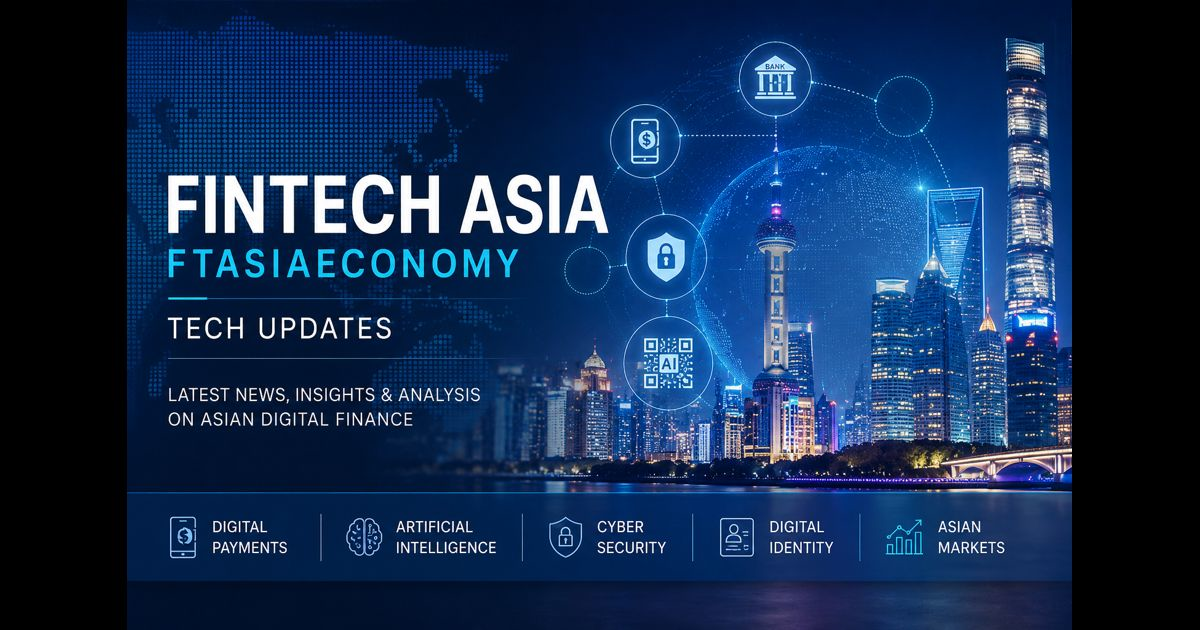
FintechAsia FTAsiaEconomy tech updates is wording used online for coverage of financial technology, digital payments, artificial intelligence, cybersecurity, and economic change across Asian markets. It should not be treated as the name of a single official financial product, regulator, bank, or investment service unless a source clearly establishes that connection.
A useful update does more than announce a new app, token, or platform. It explains what changed, which country or market it affects, who is responsible, what regulation applies, and whether the change is already operating or still being tested. That context matters because Asia contains highly different financial systems, consumer protections, payment networks, currencies, and rules.
Why Asia’s fintech changes deserve careful attention
Asia is home to some of the world’s most active digital-payment ecosystems. Mobile wallets, real-time bank transfers, QR payments, digital identity systems, e-commerce platforms, and financial APIs have changed how consumers and businesses move money.
The wider impact is not limited to convenience. Reliable payment infrastructure can support small businesses, reduce friction in commerce, improve access to formal financial services, and make some government and business payments easier to deliver. The World Bank’s overview of payment systems notes that safe and efficient payment systems support financial inclusion, economic development, and financial stability.
Yet technological adoption does not remove financial risk. Fraud, data misuse, poor identity verification, weak customer support, and unclear fees can undermine confidence quickly. Readers should therefore judge developments by their safeguards as carefully as their speed.
For a broader foundation, Fin TechAsia’s guide to financial technology explains how payments, cloud systems, analytics, cybersecurity, and digital services connect across modern finance.
The updates that matter most
Cross-border payments and QR interoperability
Cross-border payments remain more complicated than domestic payments. Currency conversion, compliance reviews, different settlement systems, and varying consumer-protection standards can add cost and delay.
Regional payment connectivity is therefore important. The Bank for International Settlements reported that ASEAN had 29 payment linkages by the end of 2025, reflecting continued work to connect payment ecosystems across borders. These arrangements can make travel, trade, and remittances more practical, but availability still depends on participating institutions, countries, currencies, transaction limits, and applicable fees.
A credible update should identify:
- The participating payment systems and jurisdictions
- Whether the connection supports merchant payments, person-to-person transfers, or both
- The currencies and foreign-exchange process involved
- Transaction limits, fees, and dispute procedures
- The date the service becomes available to the public
Artificial intelligence in finance
Financial institutions use AI for fraud monitoring, document processing, customer support, risk analysis, and operational automation. These applications can improve speed and help analysts find unusual patterns among large volumes of data.
However, financial AI should not be judged only by automation claims. A sound deployment needs reliable data, privacy controls, model testing, human escalation routes, and clear responsibility when an automated result affects a customer.
Singapore’s Monetary Authority has continued work on AI-risk guidance and financial-sector safeguards, including resources for traditional, generative, and agentic AI. This signals an important regional shift: AI in finance is increasingly a governance issue, not merely a productivity tool.
Readers who want more context can explore artificial intelligence in financial technology, including its role in fraud detection, compliance, and risk management.
Digital identity and account protection
Every digital financial service depends on trust in identity. Account opening, payment approval, password recovery, and fraud investigation all rely on the ability to verify that the right person is taking action.
Strong identity systems may use several checks, such as device signals, passwords, one-time codes, biometric confirmation, or document verification. Each method has trade-offs. A system that is too weak can enable account takeover; one that is too rigid can exclude legitimate customers or create unnecessary friction.
Updates in this area are most useful when they explain:
- What information is collected
- Whether customers can control consent for data sharing
- How long data is retained
- What happens if verification fails
- How users can report fraud or recover an account
Open finance and connected financial services
Open finance allows authorized data sharing or payment initiation through secure interfaces. In practice, this can support faster onboarding, account aggregation, budgeting tools, lending decisions, and business-finance services.
The value depends on consent and accountability. Consumers and businesses should be able to see what they are authorizing, limit access where possible, and understand how to revoke permission. A service should also make clear whether it is regulated, which institution holds customer funds, and how complaints are handled.
Open finance can increase competition and product choice, but it should never be presented as a reason to share financial credentials with an unverified service.
Digital assets, tokenisation, and settlement
Digital-asset news often receives attention because of price movements, but the more durable financial-technology question is whether a new system solves a real settlement, recordkeeping, or transfer problem safely.
Tokenised assets, stablecoins, and distributed-ledger systems may have a role in selected institutional and cross-border use cases. Their usefulness depends on legal clarity, governance, reserve quality where relevant, cybersecurity, interoperability, and a reliable route for redemption or dispute resolution.
The IMF emphasizes that digital finance can expand opportunity but also raises questions around interoperability, capital flows, monetary policy, and risk management. A balanced update should separate established operational use from proposals, pilots, and marketing claims.
How to assess a fintech update responsibly
A reliable fintech update should answer five practical questions.
Who is responsible? Identify the bank, payment provider, regulator, technology company, or public authority involved. Do not rely solely on a third-party summary.
What has actually changed? Distinguish a launched service from a partnership announcement, pilot, consultation, or future plan.
Where does it apply? Regulations and customer protections are jurisdiction-specific. A service available in Singapore may not be available or lawful in another market.
How are users protected? Look for licensing, disclosure standards, fraud controls, privacy practices, customer support, and complaint procedures.
What remains uncertain? Good reporting acknowledges limitations, implementation risk, and facts that still need confirmation.
This approach helps readers identify substance without treating every announcement as a major economic shift.
What businesses should watch
For businesses operating across Asian markets, the central issues are often practical rather than headline-driven: payment acceptance, reconciliation, currency conversion, fraud exposure, data handling, tax treatment, and local compliance.
Before integrating a new payment or financial-technology service, a business should confirm:
- Local availability and licensing status
- Settlement timing and currency conversion costs
- API reliability and documentation
- Data-processing responsibilities
- Chargeback, refund, and fraud-loss procedures
- Business continuity arrangements
- Customer-support channels during a payment failure
Technology can improve operations, but no integration should proceed on promotional claims alone.
What consumers should watch
Consumers can benefit from digital finance, but basic caution remains essential. Verify the provider through official channels, enable multi-factor authentication, review fees before confirming a transaction, and avoid sharing verification codes or login credentials.
Be particularly careful when an offer promises guaranteed returns, urgent account action, fee-free transfers without conditions, or exclusive early access to an investment product. Legitimate financial services should provide clear terms, identifiable contact information, and a way to raise a complaint.
Final thoughts
FintechAsia FTAsiaEconomy tech updates are most useful when they explain the practical relationship between financial technology and the regional economy rather than repeating broad claims about innovation.
Asia’s payments, AI systems, digital identity tools, connected finance, and cross-border infrastructure are changing quickly. The developments that deserve attention are those supported by clear evidence, accountable institutions, appropriate safeguards, and real-world usability. Readers who keep those standards in view can follow digital-finance developments with more confidence and less noise.
Frequently Asked Questions
Is FintechAsia FTAsiaEconomy Tech Updates an official financial service?
No clear public evidence identifies the wording itself as an official bank, regulator, financial product, or licensed investment service. Treat it as a topic label unless an official source confirms otherwise.
What makes an Asian fintech update reliable?
It should identify the responsible organization, country, launch status, applicable rules, consumer protections, and a primary source.
Are cross-border QR payments available throughout Asia?
No. Payment connectivity is expanding, but availability depends on participating countries, payment providers, currencies, transaction types, and local rules.
Can AI make financial services safer?
AI can help detect suspicious activity and automate routine work, but safe use also requires reliable data, oversight, privacy protection, testing, and clear accountability.
Should readers use fintech articles as financial advice?
No. General educational articles cannot replace regulated, personalized financial, legal, tax, or investment advice.